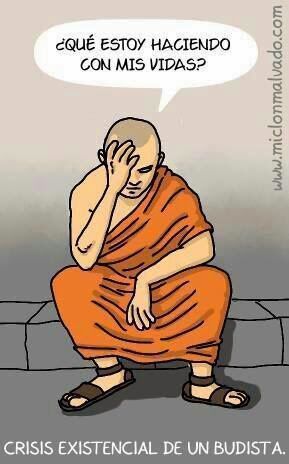
I remember it clearly, a friend's father had died and that meant the topic of conversation for weeks was death and its meaning, after long considerations, I felt as if a light bulb had switched on in my head, suddenly I understood the absurdity of fearing or worrying about death, with a truly very simple reasoning, I simply thought about what would happen an instant after dying, what happens an instant after? And my answer was what does it matter!
Indeed, an instant after one's own death or that of any other person, nothing matters, all worries cease, and that gave me an extraordinary sense of peace, and once I was at it, it occurred to me to think about the reason why I or any other person would want to transcend that moment.
If we look at it carefully, that reasoning about the instant after death and the subsequent void is enough, nothing more is needed, so why all this fuss about the need to transcend it?
It can be understood that one's own individuality, my personality, or you can also call it my ego or that of others since we all end up the same, seeks to achieve survival, but it happens that there is no reincarnation philosophy that speaks to us of the survival of that so beloved part that we so desire to make endure, it happens that we are told of a survival of the spiritual or essential part detached from all that.
Even so, there are religions that play at promising a continuity of mental identity to gain followers, this is nothing but an absurd game, you only have to look back and forward to realize that a person's identity in their childhood, adolescence, maturity, and old age is different, therefore clinging to the idea of survival of that part of ourselves with which we identify and which is immutable lacks sense.
So it happens that different currents of thought proclaim the need to create a permanent and indivisible part with which one can transcend death and enter eternity, but look, perform this experiment now, think about what part of your mind or let's say your being is protected from variation, what part does not evolve? and a better question, if we reach that part through a spiritual or mental process, how is it possible that it is not susceptible to being modified?
The only answer to this question lies in finding something that is present and is immutable, that is, it never evolved from anything before, and now tell me, do you find it? if the answer is yes and it is something associated with your personal way of seeing the world, you are mistaken, everything changes, if it is yes and you perceive it as something spiritual, then it is not what is usually pursued, since it does not belong to our own beloved personality or identity and it is not what we really desire to make remain.
Having reached this point, one must ask oneself, and why would I want reincarnation? Having reached this point, I realize that I have no desire whatsoever to endure and no interest in knowing whether I have had past lives or will have them in the future, although I am open to believing that this possibility might be true.
A large part of the control that the major religions have exercised over the population is based on the idea of a continuity after death, but such continuity is caused by a mental ghost, by an evolutionary desire to make the species endure and remain.
Furthermore, in past times the priests distributed good or bad places in heaven or hell based on the payment of debts that the church needed for the construction of its temples, therefore the best places are already taken.