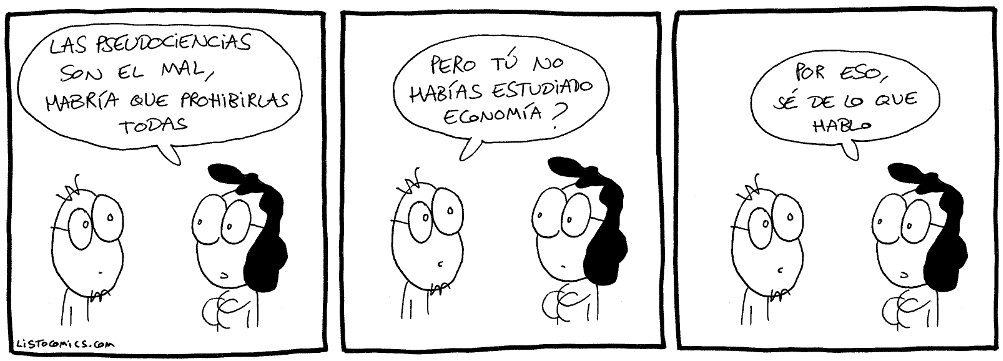
SKEPTICS OF COPIRRAIT
Distinguishing the useful from the unnecessary has always been complicated, doing so in the Internet age is beginning to be a task worthy of Ariadne, you know, that one who sought the way out of the labyrinth.
Among those defending the conspiracy theory are many individuals of "questionable objectivity" who can argue both having been abducted by extraterrestrials and having proof that certain earthquakes are evidence of secret weapons.
The opaque reality they usually show seems entirely unnecessary to me; with the objective data and evidence at our disposal, there are already sufficient indicators for sensible skepticism.
On the other hand, there exists the opposite pair, those defending the theory of skepticism, these individuals dismiss everything and use truly manipulative arguments and being viewed in a more acceptable way, they are certainly more dangerous.
Many web pages owe their notoriety and income to the existence of picturesque and strange characters, since they fill them with criticism and chest-thumping while wielding their scientific truth and reason, "we have the bigger one and that's that".
I believe that by simple arithmetic and information hygiene we would do well to strike out this pair of opposites and seek answers in a more serious manner.
Let us take as an example the case of UFOs, a few thousand cases of supposed sightings are known, however to prove the existence of extraterrestrial life only one conclusive proof is necessary.
However, there do exist cases of unidentified flying objects, which is not the same as objects foreign to the Earth.
Another example can be found in Astrology, always attacked by the church for considering it threatened the idea of God's dominion over mankind (the planets took power away from God) and later attacked by scientific fundamentalist sectors for considering it threatens what is established by the scientific method. Are we really trying to clarify things or to dominate them?
Let us make a call to reflection and struggle, to well-understood skepticism, the kind that questions whether a theory is truly valid above temporal methods.
Being skeptical is not a registered trademark like Coca-Cola; it is a constant doubt and concern to clarify the truth without feeling limited by cultural or social constraints.