We are, or at least I am, tired of hearing and seeing extraordinary news on social media that is described in a grandiose way, as if it were the last day on Earth or the end of times, and presented to us as the greatest spectacle in the world. Matters that, after a few days, fade into eternal oblivion without fanfare. That's why this celestial event is important, because from an astrological point of view, it is certainly a remarkable and striking event. Below, I will explain why, and you will see that I have my reasons.

On April 8th next, we will have a total solar eclipse that will be visible in North America. Its epicenter, where complete darkness will last the longest—4 minutes and 28 seconds—will be found in Mexico, specifically in the town of Nazas. However, the eclipse will also be total in parts of the USA and Canada, meaning all of North America will be affected by this eclipse.
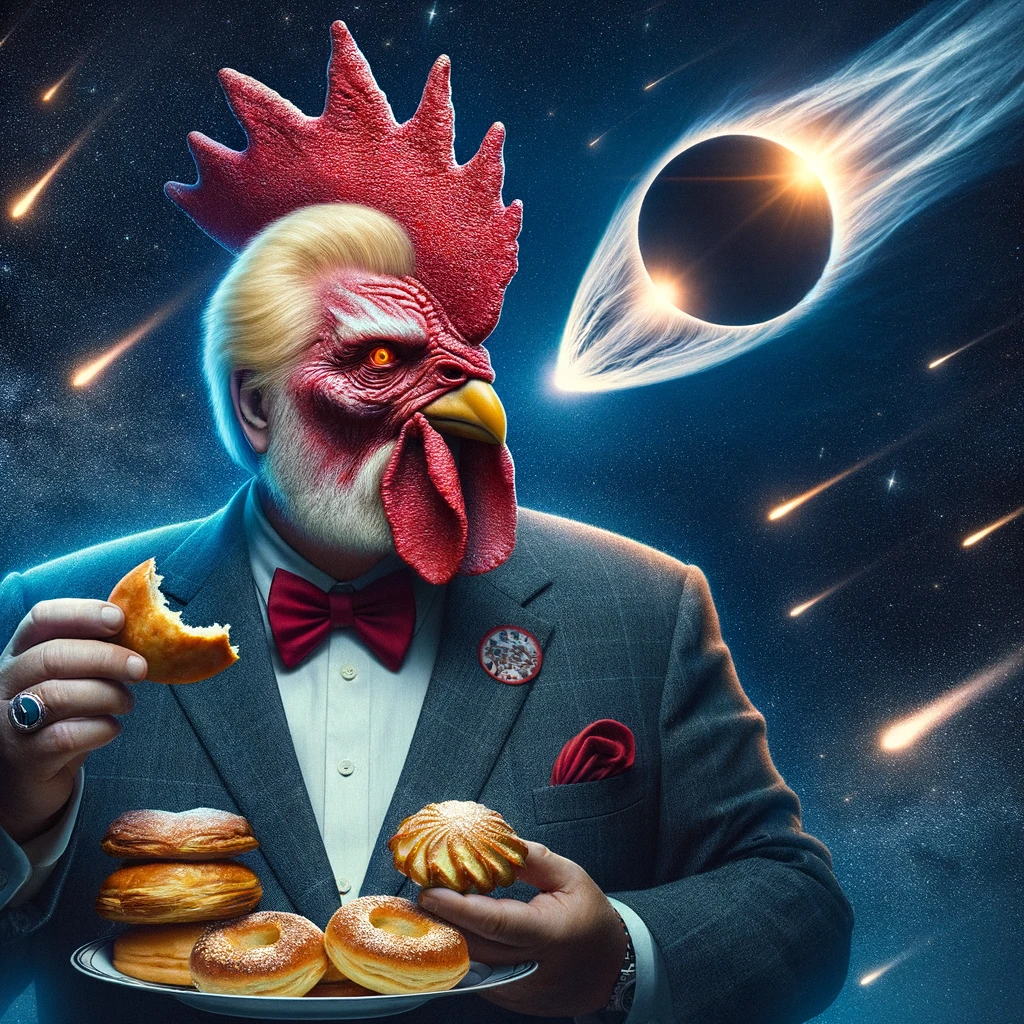
At first glance, it might seem like just another eclipse, albeit one with longer duration than usual with more than 4 minutes of complete darkness. However, a synchronistic event with the eclipse will change everything: at the exact moment of the eclipse, a comet will be observable in the sky. That is, the comet will be observable from all over Earth, but at the moment of the eclipse, those who find themselves in its places of maximum darkness will observe, almost without changing their viewing angle, a comet in the daytime sky.
And if that doesn't seem curious and sufficiently symbolic to you, I'll tell you something about this comet that surprised me. The events that occurred during the three most recent recorded passages with specific dates are remarkable. The comet 12P/Pons-Brooks, which is what it's called, has a passage cadence of 71 years. Like Halley's comet, it is a periodic visitor. This contrasts with the next comet we will see this year, C/2023 A3 (Suchinshan-ATLAS), which appears approximately every 47,000 years. Therefore, this current comet serves us to observe the events that synchronized with its appearance, and here's the surprise:
First warning: Napoleon and one of history's greatest military catastrophes.
The periodic comet Pons-Brooks was officially designated or "discovered" on July 12, 1812. Its appearance was synchronistic with several significant historical events, including the beginning of Napoleon's invasion of Russia on June 24, marking a crucial point in the Napoleonic Wars. Also, in 1812, on June 18, the United States declared war on Great Britain, initiating the War of 1812. These events had a lasting impact on European and North American history, influencing international relations and history.
Second warning: the loudest noise ever heard by humanity.
In 1883, the world witnessed one of the most catastrophic events in recorded history: the eruption of the Krakatoa volcano. This event, marked by four devastating explosions, culminated in a detonation so powerful that it is considered the loudest noise ever heard by humanity. The island of Krakatoa was consumed by fire and fury, hurling ash up to 80 km into the atmosphere and altering climates globally. This event occurred on August 27, 1883, and barely 3 days later, on September 1, the Pons-Brooks comet was recovered and studied. Its closest approach occurred on September 27 of that year.
Third warning: 1954, the atomic age.
The comet's appearance coincided with another powerful and unpleasant event: bombs detonated in May and June of 1954 as part of Operation Castle were notable for being tests of thermonuclear devices (hydrogen bombs) much more powerful than previous nuclear weapons. For example, the Castle Bravo bomb, detonated on March 1, 1954, was the most powerful of these tests and turned out to be much more potent than expected, with significant consequences in terms of radioactive exposure. These tests marked a crucial advancement in the development of nuclear weapons, demonstrating the destructive power and the political and environmental implications of thermonuclear weapons.
This comet seems to synchronize with powerful events. You'll see in many places that they call it the "devil comet," but this name is due to the shape of its coma (the comet's tail), which looks like a C, and fortunately, ancient observers of celestial events did not give comets a negative connotation, but rather to their place of appearance, that is, to the stars and constellations through which they transit during their passage. That is information I do not yet have available.
If you want to know how these or other celestial events can affect your life, request your personal astrological study here.
In any case, it's also worthwhile to observe the synchronistic events of history, and even more so when in the USA they are in a pre-election process that could change the history of the USA and the world.
@siguetuestrella.com On October eighth there will not only be a total eclipse but also the Pons-Brooks comet will be visible in North America, more information in my article on astroses.com #comet #eclipse #solareclipse pons-brooks #followyourstar #pacoastrologer #horoscope #destiny